Plan your visit to Singapore Oceanarium
The Singapore Oceanarium is a large indoor marine attraction on Sentosa, best known for its giant Open Ocean viewing panel, immersive sea jelly habitats, and story-led journey through 22 zones. It’s no longer a quick aquarium stop — most visits take half a day, and the route mixes live habitats, digital galleries, and maritime history. The biggest difference between a rushed visit and a good one is what you do first: head past the opening bottlenecks early, then loop back later. This guide covers timing, tickets, entrances, and the route to make the visit smoother.
Quick overview: Singapore Oceanarium at a glance
If you want the visit to feel calm rather than crowded, make a few decisions before you arrive.
- When to visit: Daily from 10am. The first 60–90 minutes after opening are noticeably calmer than 11am–3pm, because most tour groups and family arrivals bunch up around the opening jellyfish galleries and the Open Ocean window.
- Getting in: From SGD 55 for standard entry. Guided insider experiences from SGD 258. You can buy on the day, but weekends, June school holidays, and December are much easier if you book ahead.
- How long to allow: 3–5 hours for most visitors. It stretches toward the longer end if you stop for discovery pools, wall text, feeding sessions, or the maritime-history galleries.
- What most people miss: The Jewel of Muscat and the Whale Fall zone both add real depth to the visit, but many people rush past them on the way to the sharks and manta rays.
- Is a guide worth it? Yes for the Insider Experience or behind-the-scenes access, especially if you want science and conservation context; otherwise, a self-guided visit with the app is enough for most visitors.
Jump to what you need
Where and when to go
How much time do you need?
Which ticket is right for you?
Which animals to see
Facilities and accessibility
Where and when to go
How do you get to Singapore Oceanarium?
The Oceanarium sits inside Resorts World Sentosa on Sentosa Island, next to Universal Studios Singapore and a short hop from HarbourFront and VivoCity.
- MRT + Sentosa Express: HarbourFront MRT → VivoCity Level 3 → Resorts World Station → 3–5 min walk to Level B1 entry.
- Bus: RWS8 → Resorts World Sentosa drop-off → 5-min walk → useful if you want fewer transfers than the monorail.
- Taxi/rideshare: Drop off at Resorts World Sentosa basement or main forecourt → fastest from Marina Bay or the airport.
- Walk: Sentosa Boardwalk from VivoCity → 15–20 min → scenic, but less appealing in midday heat.
Which entrance should you use?
There is one main visitor entrance, but your experience is smoother if you arrive with a ticket already on your phone — most delays happen before the scan point, not after it.
- Mobile / pre-booked tickets: For visitors with e-tickets. Expect 5–10 min waits outside peak windows and longer security checks on weekends.
- On-site purchase / box office: For walk-ups needing tickets. Expect 15–30 min waits in busy holiday periods before you even reach security.
When is Singapore Oceanarium open?
- Daily: Doors open at 10am; closing time can vary by date, so check the day-specific calendar before you book.
- Last entry: Late afternoon entry is possible, but arriving after 4pm usually turns the 22-zone route into a rushed visit.
When is it busiest? Weekends, 11am–3pm, plus June school holidays, late December, and Lunar New Year periods are the hardest windows for clear tank views and short touch-pool waits.
When should you actually go? Weekday mornings in September or early November are the quietest sweet spot, because you get the Open Ocean dome before group traffic builds and the dark galleries feel much less compressed.
If you want the Open Ocean window without a wall of phones in front of it, arrive 30 minutes before opening and walk past the first jellyfish crowds as soon as doors open, then loop back to Ocean Wonders after 11:30am when the entrance logjam eases.
How much time do you need?
| Visit type | Route | Duration | Walking distance | What you get |
|---|---|---|---|---|
Highlights only | Entry → Ocean Wonders → Shark Seas → Open Ocean → The Abyss → exit | 2–2.5 hrs | ~2km | You’ll see the big visual moments fast, but you’ll skim past the maritime-history sections, discovery activities, and most of the slower educational zones. |
Balanced visit | Entry → Ancient Waters → Spirit of Exploration → Singapore’s Coast → Shark Seas → Open Ocean → Benthos → Whale Fall → Ocean’s Future | 3.5–4.5 hrs | ~4km | This is the best fit for most visitors because it keeps the signature habitats and adds the Jewel of Muscat, mangroves, and deep-sea storytelling that make the new layout feel richer. |
Full exploration | Full 22-zone route + discovery pools + app interactives + feeding or add-on experience | 5–6+ hrs | ~5km | This gives you the complete narrative arc and the science layers most people skip, but it’s a long indoor walk and families usually need a food or rest break partway through. |
The standard route works with basic entry, while dolphin programmes, guided experiences, and combos require upgraded or bundled options (see table above).
The full exploration route is harder to pull off without local knowledge. Timed sessions and spread-out zones make navigation tricky—guided or upgraded options help you cover more efficiently and add context.
Which Singapore Oceanarium ticket is best for you
| Ticket type | What's included | Best for | Price range |
|---|---|---|---|
Singapore Oceanarium Tickets | Entry to 22 zones + shows, talks, and meal/retail vouchers | A standard visit covering all core exhibits at your own pace | From ~SGD 44 |
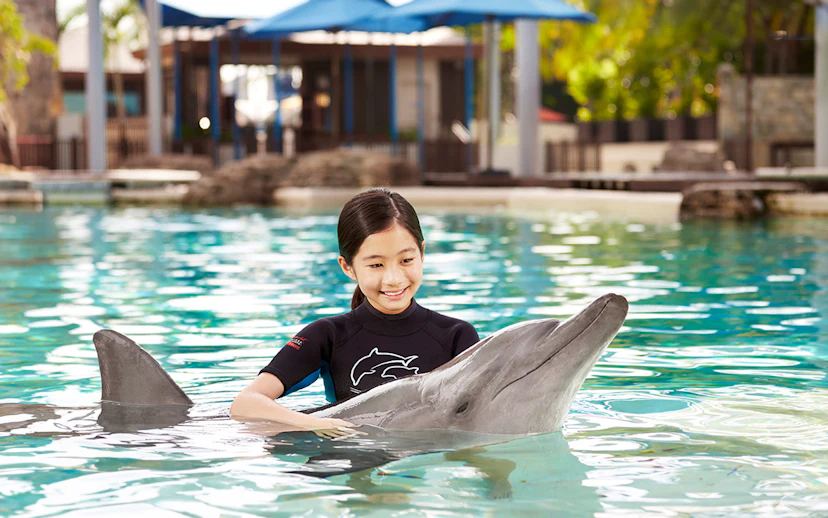
Oceanarium + Dolphin Moments | Entry + dolphin interaction (observer / shallow water / snorkel options) | Visitors who want a hands-on or close-up dolphin experience | From ~SGD 75 |
Animal Spotlight & Ocean in Focus | Entry + 45–90 min expert-led session + behind-the-scenes access | A deeper, guided visit with restricted-area access and expert context | From ~SGD 75-82 |
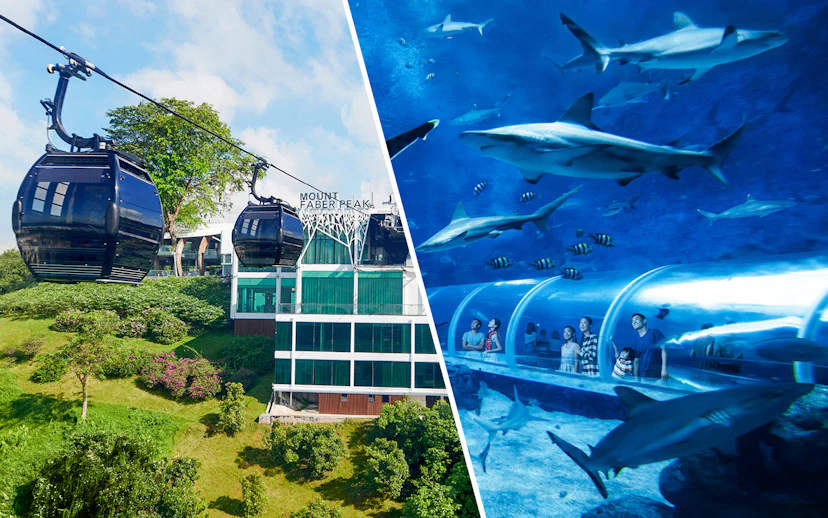
Combo: Cable Car + Oceanarium | Oceanarium entry + round-trip cable car ride | Visitors pairing sightseeing with the aquarium in one itinerary | From ~SGD 72 |
Combo: Universal Studios + Oceanarium | Oceanarium entry + full-day theme park access | Visitors combining rides + marine life in one trip | From ~SGD 116 |
Combo: Adventure Cove + Oceanarium | Oceanarium entry + waterpark access | Families mixing water rides with aquarium visit | From ~SGD 74 |
How do you get around Singapore Oceanarium?
Layout and suggested route
The Oceanarium is sprawling but mostly linear, with 22 zones arranged as a chronological ‘odyssey’ rather than a simple fish-by-fish layout. In practice, that makes it easy to follow forward, but easy to under-value the middle chapters if you only chase the biggest tanks.
- Chapter 1 — In the beginning: Ancient oceans, fossils, animatronics, and Ocean Wonders → budget 35–45 min.
- Chapter 2 — At the surface: Jewel of Muscat, mangroves, and discovery experiences → budget 45–60 min.
- Chapter 3 — Sunlight zone: Shark tunnel and Open Ocean habitat → budget 45–60 min.
- Chapter 4 — Benthos: Seafloor species and interactive displays → budget 20–30 min.
- Chapter 5 — The abyss: Deep-sea exploration, submersible displays, and Whale Fall → budget 20–30 min.
- Chapter 6 — A new horizon: Climate and conservation storytelling → budget 10–20 min.
Suggested route: If you’re arriving at opening, go straight to Shark Seas and Open Ocean first, then double back to Ocean Wonders and Ancient Waters later; most visitors do the opposite, which is why the first galleries clog quickly while the best big-tank views are still quiet.
Maps and navigation tools
- Map: Digital map/in-app guide → covers all 22 zones and the chapter flow → download it before arrival.
- Signage: Good for staying on the main route, but not good enough for hidden lifts or stroller-friendly shortcuts.
- Audio guide/app: The app adds AR and interpretation layers → worth using if you want more than a visual walk-through.
- Large outdoor POIs only: Not applicable.
Pro tip: Download the map before security — the hardest navigation problem here isn’t the route itself, it’s finding the less-obvious lift connections once you’re inside.
Which animals and habitats should you prioritise?

Ocean Wonders
Habitat type: Sea jelly habitat
This is one of the most visually striking parts of the building, with giant kreisel tanks and low-lit galleries that make the jellies look suspended in mid-air. It’s worth slowing down here because the scale is unusual even by major aquarium standards. What most people miss is that the side angles often give a cleaner full-tank view than the crowded center photo spot.
Where to find it: Early in the route, just after the opening arrival sequence in Chapter 1.
Shark Seas
Habitat type: Shark tunnel
This is the classic overhead-tunnel moment, with sand tiger sharks and other species moving directly above you. It’s most rewarding when the path is still quiet, because once groups bunch up, people stop in the middle and the flow breaks down fast. What many visitors rush past is the species detail along the side panels, which helps make sense of what’s actually overhead.
Where to find it: Mid-route in Chapter 3, before the Open Ocean habitat.
Open Ocean habitat
Habitat type: Pelagic tank
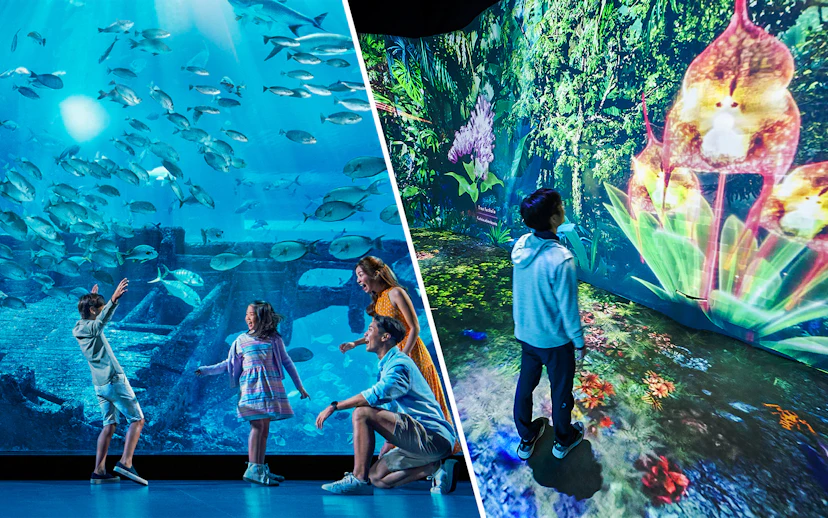
This is the Oceanarium’s signature space — the giant viewing panel, manta rays, and the calmest place in the building if you catch it early. It’s worth sitting for 20–30 minutes instead of treating it as a photo stop. What many people miss is the quieter side seating area, which often gives a better uninterrupted view than the centerline crowd.
Where to find it: Chapter 3, immediately after Shark Seas.
Singapore’s Coast
Habitat type: Mangrove and coastal ecosystem
This zone feels smaller than the big headline tanks, but it adds something the larger habitats don’t — a local, close-up sense of how coastal life actually works. Mudskippers, archerfish, and interactive discovery moments make it especially strong for families. What most visitors miss is the cleaner shrimp activity, usually because they move on after the dhow and don’t realize there’s a timed interactive element nearby.
Where to find it: Chapter 2, after the Spirit of Exploration galleries.
Whale Fall
Habitat type: Deep-sea ecosystem
This is one of the smartest exhibits in the new layout because it explains deep-sea life through a single event: what happens when a whale carcass sinks to the ocean floor. It’s less flashy than the sharks, but more distinctive. What people often miss is the bioluminescent projection work and how it ties the real specimens to the ecological story.
Where to find it: Chapter 5, in the Abyss section toward the later part of the route.
Benthos
Habitat type: Seafloor habitat
Benthos is easy to underestimate because it sits between bigger set-piece zones, but it rewards anyone who slows down for species detail. The appeal here is in the crevice life, giant crabs, and creatures adapted to a less theatrical environment. What most people rush past is the interactive table layer, which helps decode species behavior instead of leaving the tanks as simple look-and-move-on displays.
Where to find it: Chapter 4, after Open Ocean and before the deep-sea galleries.
Don't miss the interactive zones like Singapore’s Coast (where you can try the cleaner shrimp experience) and the deep-sea Whale Fall gallery—these are either overshadowed by larger tanks or come late in the route when most visitors rush through.
Facilities and accessibility
- Cloakroom/lockers: Lockers are available in the Resorts World Sentosa basement levels, and large bags are discouraged inside, even if small bags are allowed after inspection.
- Restrooms: Restrooms are spread through the route, and the most spacious family-friendly restrooms are near the Spirit of Exploration zone.
- Cafe/restaurant/food stalls: Explorer’s Nook and Tidal Deli cover the on-site food option, but they work better as convenience stops than value meals.
- Gift shop/merchandise: The main retail stop is the Singapore Oceanarium Store at the exit, where most visitors end up if their bundle includes vouchers.
- Seating/rest areas: The best built-in rest stop is around the Open Ocean viewing area, where sitting for a while actually improves the visit.
- Parking: Parking is available at Resorts World Sentosa, but driving is less hassle-free than public transit on peak weekends.
- Mobility: The venue is climate-controlled and stroller-friendly in principle, but some chapter transitions depend on poorly signposted lifts and hydraulic platforms that can slow down wheelchair users and families.
- Visual impairments: Low-light galleries, dark tanks, and reflective glass make this harder to navigate visually than many museums, so it’s worth asking staff for route help at the entrance instead of relying only on signs.
- Cognitive and sensory needs: The first hour after opening is the least overwhelming window, while the darkest and most intense zones tend to be the deep-sea sections and crowded shark areas.
- Families and strollers: Strollers are allowed, but the route is not smoothly pushchair-friendly end-to-end unless you actively ask for lift directions as you go.
Singapore Oceanarium works well for children because it mixes big visual habitats, sensory moments, and enough interactivity to break up a long indoor walk.
- Time: 3–4 hours is realistic with young children, and the best priorities are Ocean Wonders, Singapore’s Coast, Shark Seas, and Open Ocean.
- Facilities: Family restrooms are easiest around Spirit of Exploration, and the discovery-style zones give kids a reason to pause between darker galleries.
- Engagement: Save the cleaner shrimp station and discovery pools for before lunch, because waits build quickly by midday.
- Logistics: Bring a light layer for the colder abyss-style galleries and a fully charged phone if you plan to use the app’s interactive features.
- After your visit: Adventure Cove Waterpark is the easiest nearby follow-up if your children still have energy and want a second marine-themed stop.
Rules and restrictions
What you need to know before you go
- Entry requires a valid date-specific ticket, and resident fares only work if you can show the right ID at entry.
- Small bags are usually fine after inspection, but large bags slow security and are better left in lockers before you enter.
- Re-entry is allowed only if you get the invisible stamp before leaving, so don’t walk out for lunch assuming you can come straight back in without it.
Not allowed
- Outside food and drink are generally not permitted inside, so plan café stops before or after the route unless you have a medical need.
- Smoking and vaping aren’t part of the indoor experience, so use only designated outdoor areas if available in the wider resort.
- Pets are not allowed, while service animals should be checked directly with the venue before arrival.
- Flash photography, tripods, and touching habitats outside designated interactive areas are restricted to protect animals and keep the route moving.
Photography
- Personal photography is allowed in most galleries, but the practical rule is stricter than it sounds because the building is dark and many tanks are reflective.
- Flash is not appropriate, and tripods, selfie sticks, or professional production setups are best left out of the plan.
- If you want clear photos, focus on wider tanks and arrive early rather than expecting bright, easy shots in the deeper galleries.
Good to know
- ‘Skip-the-line’ style ticketing only saves you the box-office wait — it does not remove security checks or internal lines at discovery zones.
- The biggest planning mistake is arriving after 4pm and expecting a full visit, because the route is long enough that late entry turns the experience into a speed-run.
Practical tips
- Book with your real pace in mind: The official route can be done fast, but most first visits take 3–5 hours, so don’t book a tight Sentosa lunch or show immediately afterward.
- Arrive before 10am, not at 10am: Being in line about 30 minutes before opening is what gets you a calm Shark Seas and Open Ocean window; arriving right at opening still puts you behind the first photo crowd.
- Don’t judge the visit by the first 20 minutes: The entrance jellies are beautiful but congested, and the building opens up much more once you reach the larger pelagic zones.
- Save your energy for the middle chapters: Many people slow down too much in Chapter 1, then rush the Jewel of Muscat, mangroves, and Whale Fall later when the newer storytelling gets more interesting.
- Carry less than you think you need: A small bag moves through checks faster, and a 5km indoor route feels longer if you’re juggling jackets, snacks, and camera gear.
- Eat outside if you want better value: Explorer’s Nook and Tidal Deli are convenient, but Malaysian Food Street outside in the RWS plaza is the smarter lunch break if you’ve planned re-entry properly with a stamp.
- Don’t pay for every photo upsell on instinct: Entrance and tank-side photo offers are pushed hard, but staff will often help take a picture on your own phone if you ask.
What else is worth visiting nearby?
Commonly paired: Universal Studios Singapore
Universal Studios Singapore
Distance: 200m — 3-min walk
Why people combine them: It’s the most convenient same-resort pairing, and the contrast works well — one half-day indoors and calm, one half-day louder and ride-heavy.
Commonly paired: Adventure Cove Waterpark
Adventure Cove Waterpark
Distance: 450m — 6-min walk
Why people combine them: It keeps the marine theme going, but in a much more active format, so families often do the Oceanarium on a hotter morning and the waterpark on a second day.
Also nearby
SkyHelix Sentosa
Distance: 1.5km — 20-min walk or short transit hop
Worth knowing: It’s a good late-afternoon add-on if you want views after a long indoor visit rather than another heavy attraction.
Sentosa Sensoryscape
Distance: 1.2km — 15-min walk
Worth knowing: This works better as a decompression stroll than a major second attraction, especially if you’ve spent hours in dark galleries and want fresh air.
Eat, shop and stay near Singapore Oceanarium
- On-site: Explorer’s Nook and Tidal Deli serve themed snacks and quick bites inside the venue area, but they’re best treated as convenience stops rather than the best-value meal on Sentosa.
- Malaysian Food Street: 5-min walk, RWS Forum; hawker-style Malaysian and Singaporean dishes at friendlier prices than the in-venue cafés, and the best nearby choice if you want a proper post-visit meal.
- Explorer’s Nook: inside the attraction zone; useful for a fast drink or snack break when you don’t want to interrupt the route.
- Tidal Deli: inside the attraction zone; a practical fallback for families who need something quick without leaving Resorts World Sentosa.
- Pro tip: If you plan to leave for lunch, get the re-entry stamp first — Malaysian Food Street is the better-value meal, but only if you don’t accidentally forfeit your return.
- Singapore Oceanarium Store: The main gift shop at the exit, best for visit-specific souvenirs and the easiest place to use any included retail vouchers.
- Resorts World Sentosa retail area: Better if you want a broader mix of general Sentosa souvenirs rather than aquarium-only merchandise.
Staying on Sentosa is convenient, but it’s usually a short-stay convenience play rather than the smartest base for an entire Singapore trip. You’ll be close to the Oceanarium, Universal Studios Singapore, and the rest of Resorts World Sentosa, but hotel prices are typically higher than many city neighborhoods. It suits families and short trips best.
- Price point: Sentosa skews expensive, especially for resort hotels, with fewer budget-friendly options than the city.
- Best for: Visitors who want to walk to the entrance and keep logistics simple for children or a packed Sentosa itinerary.
- Consider instead: HarbourFront is a better all-round base if you want cheaper hotels and fast access to Sentosa, while Marina Bay or Chinatown suit longer stays better if the Oceanarium is only one part of your trip.
Frequently asked questions about visiting Singapore Oceanarium
Most visits take 3–5 hours, and a full slow-paced visit can stretch past 5 hours. The route now covers 22 zones, so it’s no longer a quick 1-hour aquarium stop. Families usually need more time because discovery pools, snack breaks, and repeat stops at the Open Ocean window slow the pace naturally.
No, you don’t always need to book in advance, but it’s the safer move on weekends, school holidays, and in December. Same-day entry is often possible, especially on weekdays, but advance booking makes timing easier and avoids the extra friction of on-site ticket purchase before security.
It’s only partly worth it, because it skips the box office rather than every line. Mobile tickets help you avoid ticket-purchase waits, but they do not remove bag checks or internal queues at places like the discovery pools. If your main goal is time-saving, arriving early matters more than the ticket label.
Arrive about 30 minutes before opening if you want the calmest start. That gives you the best chance of reaching Shark Seas and the Open Ocean habitat before the first major crowd wave forms. If you arrive right at 10am, you’ll still hit the first photo bottlenecks with everyone else.
Yes, you can bring a small bag or backpack, but large bags are a bad idea. Security checks are quicker with a smaller bag, and the full route is long enough that carrying too much gets annoying fast. If you’re carrying bulky items, use the lockers in the Resorts World Sentosa basement before entering.
Yes, personal photos are allowed in most areas, but flash and large equipment are a poor fit here. The galleries are dark, reflections are common, and many visitors find the lighting frustrating for casual photography. Tripods and similar gear are best left out of the plan.
Yes, group visits are common, but they change the feel of the busiest zones. Tour groups tend to bunch up between 11am and 3pm, especially at the sharks and Open Ocean window. If you’re visiting with your own group, start early and agree on meeting points because stopping in the main flow creates instant congestion.
Yes, it works very well for families, especially with toddlers and elementary-school children. The combination of large tanks, dark-but-not-chaotic galleries, and interactive zones holds attention well. Just budget at least 3–4 hours, and do the discovery-style stops earlier in the day before queues build.
Yes, but the accessibility is less intuitive than it should be. The venue is indoor and climate-controlled, and wheelchairs or strollers are allowed, but some lift connections are hard to find and can slow the visit. If mobility matters, ask staff for the lift route right at the entrance rather than discovering it section by section.
Yes, food is available both inside the wider venue area and just outside in Resorts World Sentosa. Explorer’s Nook and Tidal Deli are the easy internal options, while Malaysian Food Street is the stronger value play nearby. If you plan to exit for lunch, make sure you get the re-entry stamp first.
Yes, re-entry is possible only if you get the invisible stamp before you exit. That matters if you want a cheaper lunch outside or need a longer break. Without the stamp, leaving effectively ends your visit, so sort that out before you step out of the attraction.
The best time is the first hour after opening, ideally before 11am. That’s when the viewing area is quiet enough to sit and actually watch the tank rather than photograph around other people. By midday, the space is still impressive, but much less calm and much harder for uninterrupted viewing.